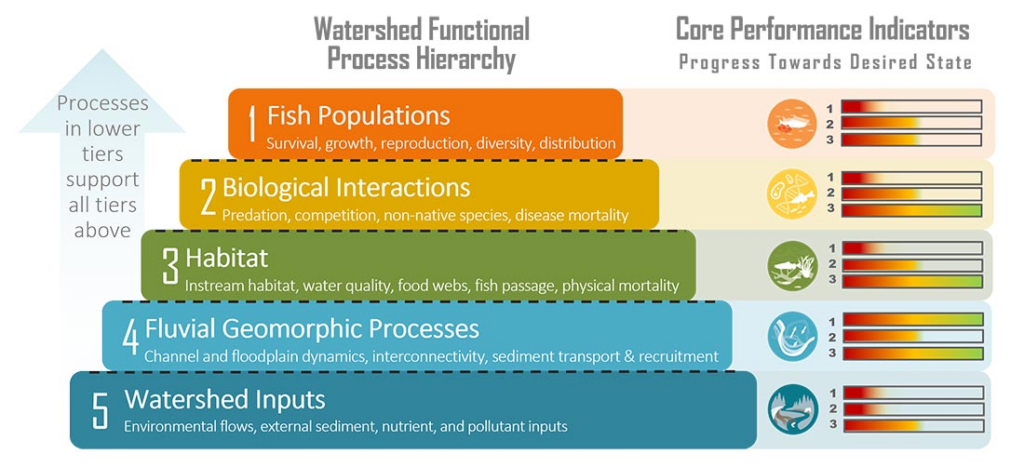
Core Performance Indicators (CPIs) serve as the watershed’s vital signs—fundamental measures that assess overall basin health and track progress toward restoration objectives and basin-wide goals within the different biophysical tiers. The CPI categories directly align with all IFRMP restoration goals except Tier 2 Fisheries Actions, which fall outside the IFRMP’s scope. Given the Klamath Basin’s large size and nested sub-basins, the CPIs are applied across multiple spatial scales, from individual sites and reaches to tributaries, sub-basins, and the entire basin.
Five CPI Categories
Tier 1 Fish Population Indicators
Focal fish species presence/absence and distribution
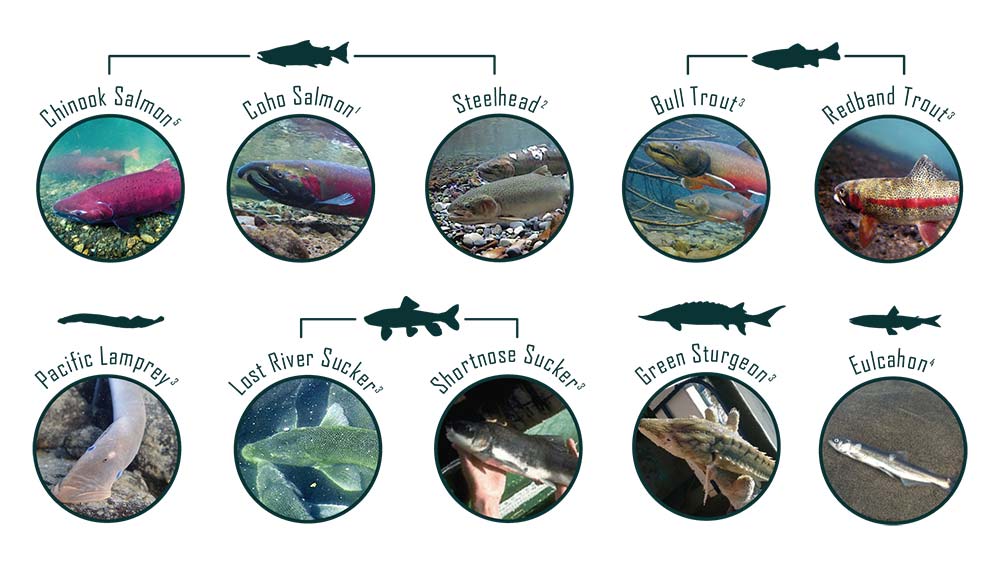
Focal Fish Species include:
Salmon: Chinook Salmon, Coho Salmon, Steelhead
Trout: Redband Trout, Bull Trout
Suckers: Shortnose sucker, Lost River sucker
Other Native Species: Pacific Lamprey, Eulachon, Green Sturgeon
Percentage of historical habitat occupies
Spawning and rearing presence
Population abundance and productivity
Life history and genetic diversity
Age structure/demographics
Chart of focal species for the CPI fish population indicators
Tier 2 Biological Interaction Indicators
Prevalence of disease pathogens and mortality
Presence of invasive aquatic species
Tier 4 Geomorphic Process Indicators
Sediment transport and storage
Channel complexity and stability
Floodplain connectivity
Riparian vegetation condition
Tier 3 Habitat Quality Indicators
Stream temperature regimes
Water quality parameters
Habitat connectivity measures
Cold-water refugia availability
Tier 5
Watershed Input Indicators
Flow regimes and water quantity
Water quality parameters
Nutrient and pollutant loading
Sediment delivery rates
Hierarchical framework illustrating how CPI categories align with IFRMP watershed restoration goals and objectives.